

How To Draw A Diagonal Line On A Cylinder Surface In Sketchup

Geometry is the branch of mathematics that deals with points, lines, shapes, and angles. SAT geometry questions volition test your noesis of the shapes, sizes, and volumes of different figures, as well as their positions in infinite.
25-30% of SAT Math problems volition involve geometry, depending on the detail test.
Considering geometry equally a whole covers and so many different mathematical concepts, there are several different subsections of geometry (including planar, solid, and coordinate). Nosotros will cover each branch of geometry in divide guides, complete with a step-by-pace approach to questions and sample problems.
This article will be your comprehensive guide to solid geometry on the Sat. We'll take yous through the pregnant of solid geometry, the formulas and understandings y'all'll need to know, and how to tackle some of the most difficult solid geometry problems involving cubes, spheres, and cylinders on the Saturday.
Earlier you continue, keep in mind that at that place volition usually only exist 1-2 solid geometry questions on any given Sat, so y'all should prioritize studying planar (apartment) geometry and coordinate geometry kickoff. Salvage learning this guide for concluding in terms of your SAT math prep.
 Earlier you descend into the realm of solid geometry, brand sure you are well versed in plane geometry and coordinate geometry!
What is Solid Geometry?
Solid geometry is the name for geometry performed in iii dimensions. Information technology means that another dimension—volume—is added to planar (flat) geometry, which only uses superlative and length.
Instead of flat shapes like circles, squares, and triangles, solid geometry deals with spheres, cubes, and pyramids (along with whatever other 3 dimensional shapes). And instead of using perimeter and area to measure flat shapes, solid geometry uses surface area and volume to measure its three dimensional shapes.

A circle is a flat object. This is plane geometry.

A sphere is a iii-dimensional object. This is solid geometry.
On the SAT, near of the solid geometry problems are located at the finish of each department. This means solid geometry problems are considered some of the more than challenging questions (or ones that will take the longest amount of time, as they often demand to be completed in multiple pieces). Use this noesis to direct your study-focus to the almost productive avenues.
If you are getting several questions wrong in the beginning and middle sections of each math section, it might be more than productive for you to take the time to first refresh your overall understanding of the math concepts covered by the Saturday. You can likewise bank check out how to improve your math score or refresh your understanding of all the formulas you'll need.
Note: near of the solid geometry SAT Math formulas are given to you on the exam, either in the formulas box or on the question itself. If you lot are unsure which formulas are given or not given in the math section, refresh your formulas cognition.

This is the formula box you lot'll be given on all Sabbatum math sections. You are given the formulas for both the book of a rectangular solid and the volume of a cylinder. Other formulas volition often be given to you in the question itself.
Just while many of the formulas are given, it is nevertheless important for yous to empathise how they piece of work and why. So don't worry too much near memorizing them, but practice pay attending to them in guild to deepen your agreement of the principles backside solid geometry on the SAT.
In this guide, I've divided the approach to SAT solid geometry into three categories:
#1: Typical Sabbatum solid geometry questions
#2: Types of geometric solids and their formulas
#iii: How to solve an SAT solid geometry trouble with our Sat math strategies
 Solid geometry adventure hither we come up!
Typical Solid Geometry Questions on the SAT
Before we go through the formulas y'all'll need to tackle solid geometry, it's of import to familiarize yourself with the kinds of questions the Sat volition ask yous about solids. Sat solid geometry questions will appear in two formats: questions in which you are given a diagram, and word trouble questions.
No matter the format, each type of Sat solid geometry question exists to examination your understanding of the book and/or surface area of a figure. Yous volition be asked how to find the volume or surface surface area of a figure or you'll be asked to place how a shape's dimensions shift and change.
Diagram Problems
A solid geometry diagram problem will provide yous with a cartoon of a geometrical solid and ask y'all to detect a missing element of the picture. Sometimes they will enquire you to find the volume of the figure, the surface area of the figure, or the altitude between two points on the figure. They may likewise ask you to compare the volumes, surface areas, or distances of several different figures.

This is a typical "comparing solids" SAT question. Nosotros'll go through how to solve it later in the guide.
Word Bug
Solid geometry word problems will usually ask yous to compare the surface areas or volumes of two shapes. They will often give you the dimensions of one solid and and so tell you lot to compare its book or surface area to a solid with different dimensions.
By how many cubic feet is a box with a height of 2 inches, a width of half dozen inches, and a depth of 1 inch greater than a cylinder with a peak of iv inches and a diameter of 6 inches?
This is a typical word problem question that might announced in the grid-in department of the SAT math
Other give-and-take problems might inquire you to incorporate one shape within another. This is just another style of getting you to call up most a shape'south volume and ways to measure information technology.
What is the minimum possible volume of a cube, in cubic inches, that could inscribe a sphere with a radius of 3 inches?
A) $12√3$ (approximately $20.78$)
B) $24√3$ (approximately $41.57$)
C) $36√3$ (approximately $62.35$)
D) $216$
E) $1728$
This is a typical inscribing solids discussion problem. We'll get through how to solve it later in the guide.
Solid geometry word problems tin can be disruptive to many people, because it can exist difficult to visualize the question without a picture.
Equally always with word problems that describe shapes or angles, make the drawing yourself! Merely being able to see what a question is describing tin can practice wonders to assistance clarify the question.
Overall Manner of Solid Geometry Questions
Every solid geometry question on the Sat is concerned with either the volume or surface area of a effigy, or the distance between 2 points on a figure. Sometimes you'll have to combine surface area and volume, sometimes you'll have to compare 2 solids to one another, but ultimately all solid geometry questions boil down to these concepts.
And then now permit's go through how to notice volumes, surface areas, and distances of all the different geometric solids on the SAT.

A perfect example of geometric solids in the wild
Prisms
A prism is a three dimensional shape that has (at least) 2 congruent, parallel bases. Basically, y'all could pick up a prism and bear it with its opposite sides lying apartment against your palms.
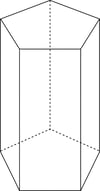


A few of the many different kinds of prisms.
Rectangular Solids
A rectangular solid is substantially a box. It has 3 pairs of reverse sides that are congruent and parallel.

Volume
$\Volume = lwh$
The volume of a figure is the measure of its interior infinite.
- $l$ is the length of the figure
- $w$ is the width of the figure
- $h$ is the pinnacle of the effigy
Discover how this formula is the same as finding the expanse of the square ($A = lw$) with the added dimension of height, as this is a three dimensional figure

Offset, identify the blazon of question—is it request for volume or surface area? The question asks about the interior space of a solid, then information technology's a volume question.
Now we need to find a rectangular book, simply this question is somewhat tricky. Notice that we're finding out how much water is in a particular fish tank, just the water does not make full up the entire tank. If we just focus on the water, we would detect that it has a volume of:
$V = lwh$ => $(4)(iii)(1) = 12\cubic\feet$
(Why did we multiply the feet and width by one instead of two? Considering the water simply comes upward to one human foot; information technology does not fill up the unabridged 2 feet of height of the tank)
Now nosotros are going to put that 12 cubic feet of water into a second tank. This 2d tank has a full volume of:
$5 = lwh$ => $(3)(2)(four) = 24\cubic\feet$
Although the second tank can agree 24 cubic feet of water, we are but putting in 12. So $12/24 = i/2$.
The h2o will come up at exactly half the height of the second tank, which means the answer is D, two feet.
 Either way, those fish won't be very happy in half a tank of water
Expanse
$\Surface\surface area = 2lw + 2lh + 2wh$
In order to find the surface area of a rectangular prism, you are finding the areas for all the flat rectangles on the surface of the effigy (the faces) and then adding those areas together.
In a rectangular solid, there are six faces on the outside of the effigy. They are divided into three congruent pairs of reverse sides.

If you lot find information technology difficult to picture show surface area, remember that a die has half-dozen sides.
So you are finding the areas of the iii combinations of length, width, and height (lw, lh, and wh), which yous then multiply past ii because at that place are two sides for each of these combinations. The resulting areas are then all added together to get the surface surface area.
Diagonal Length
$\Diagonal = √[l^2 + w^2 + h^2]$
The diagonal of a rectangular solid is the longest interior line of the solid. Information technology touches from the corner of ane side of the prism to the opposite corner on the other.

Y'all can find this diagonal past either using the to a higher place formula or by breaking up the figure into two apartment triangles and using the Pythagorean Theorem for both. Yous tin can always practise this is you practise not want to memorize the formula or if you're afraid of mis-remembering the formula on test solar day.
First, notice the length of the diagonal (hypotenuse) of the base of operations of the solid using the Pythagorean Theorem.

$c^2 = 50^2 + w^2$
Side by side, use that length as i of the smaller sides of a new triangle with the diagonal of the rectangular solid as the new hypotenuse.

$d^2 = c^two + h^2$
And solve for the diagonal using the Pythagorean Theorem again.
Cubes
Cubes are a special type of rectangular solid, simply similar squares are a special blazon of rectangle
A cube has a height, length, and width that are all equal. The half dozen faces on a cube'south surface are besides all congruent.
Volume
$\Volume = s^3$
- $southward$ is the length of the side of a cube (whatsoever side of the cube, every bit they are even so).
This is the same affair as finding the volume of a rectangular solid ($v = lwh$), but, because their sides are all equal, you can simplify it by saying $s^3$.
 First, identify what the question is asking y'all to do. You lot're trying to fit smaller rectangles into a larger rectangle, so yous're dealing with book, not surface area. Find the book of the larger rectangle (which in this case is a cube):
And then you can utilize the formula for the volume of a cube:
$\Volume = due south^3$ => $six^iii = 216$
Or you tin can utilize the formula to find the volume of any rectangular solid:
$\Volume = lwh$ => $(6)(6)(6) = 216$
At present detect the volume of one of the smaller rectangular solids:
$\Volume = lwh$ => $(3)(ii)(1) = 6$
And divide the larger rectangular solid by the smaller to find out how many of the smaller rectangular solids can fit within the larger:
$216/6 = 36$
And so your final answer is D, 36
Surface Expanse
$\Surface\area = 6s^2$
This is the aforementioned formulas every bit the surface expanse for a rectangular solid ($SA = 2lw + 2lh + 2hw$). Considering all the sides are the same in a cube, you tin can see how $6s^2$ was derived:
$2lw + 2lh + 2hw$ => $2ss + 2ss + 2ss$ => $2s^ii + 2s^ii + 2s^ii$ => $6s^2$
Diagonal Length
$\Diagonal = southward√3$
Merely as with the rectangular solid, you can break up the cube into ii flat triangles and use the Pythagorean Theorem for both as an alternative to the formula.
This is the exact same procedure equally finding the diagonal of a rectangular solid.
First, find the length of the diagonal (hypotenuse) of the base of the solid using the Pythagorean Theorem.
Adjacent, use that length as 1 of the smaller sides of a new triangle with the diagonal of the rectangular solid as the new hypotenuse.
Solve for the diagonal using the Pythagorean Theorem again.
Cylinders
A cylinder is a prism with 2 circular bases on its contrary sides

Notice how this trouble only requires you to know that the basic shape of a cylinder. Draw out the figure they are describing.
If the bore of its circular bases are 4, that means its radius is 2. At present we accept two side lengths of a right triangle. Use the Pythagorean Theorem to find the length of the hypotenuse.
$ii^2 + 5^2 = c^2$ => $29 = c^2$ => $c = √29$, or answer C
Volume
$\Book = πr^2h$
- $π$ is the universal constant, also represented equally iii.14(159)
- $r$ is the radius of the circular base. It is any straight line drawn from the eye of the circumvolve to the circumference of the circle.
- $h$ is the acme of the circle. Information technology is the straight line drawn connecting the two circular bases.
This problem requires you to sympathize how to get both the volume of a rectangular solid and the volume of a cylinder in order to compare them.
A right circular cylinder with a radius of ii and a pinnacle of iv volition have a volume of:
$V = πr^2h$ => $π(two^2)(4) = 16π$ or $50.27$
The volumes for the rectuangular solids are found by:
$V = lwh$
So solid A has a volume of $(three)(3)(three) = 27$
Solid B has a book of $(four)(3)(iii) = 36$
Solid C has a volume of $(v)(4)(three) = 60$
Solid D has a volume of $(4)(4)(4) = 64$
And solid Eastward has a volume of $(four)(4)(3) = 48$
So the answer is E, 48
Surface Area
$\Surface\area = 2πr^two +2πrh$
To discover the surface area of a cylinder, y'all are adding the volume of the two round bases ($2πr^2$), plus the surface of the tube as if it were unrolled ($2πrh$).
The surface of the tube tin can also be written as $SA = πdh$, considering the diameter is twice the radius. In other words, the surface of the tube is the formula for the circumference of a circle with the additional dimension of summit.
Not-Prism Solids
Non-prism solids are shapes in three dimensions that do not have any parallel, congruent sides. If you picked these shapes up with your mitt, a maximum of one side (if whatsoever) would lie flat against your palm.
Cones
A cone is similar to a cylinder, only has simply one circular base instead of ii. Its opposite stop terminates in a indicate, rather than a circle.

There are two kind of cones—right cones and oblique cones. For the purposes of the SAT, you just have to concern yourself with right cones. Oblique cones are restricted to the math I and 2 subject area tests.
A right cone has an apex (the terminating point on top) that sits direct above the center of the cone'due south round base.
When a height ($h$) is dropped from the apex to the center of the circle, it makes a correct angle with the circular base.
Volume
$\Volume = 1/3πr^2h$
- $π$ is a abiding, written every bit iii.14(159)
- $r$ is the radius of the circular base
- $h$ is the height, drawn at a right angle from the cone'due south apex to the eye of the circular base
The volume of a cone is $i/3$ the volume of a cylinder. This makes sense logically, as a cone is basically a cylinder with i base collapsed into a signal. So a cone'south volume will exist less than that of a cylinder.
Expanse
$\Surface\area = πr^2 + pirl$
- $50$ is the length of the side of the cone extending from the apex to the circumference of the round base
The surface expanse is the combination of the surface area of the circular base ($πr^2$) and the lateral surface area ($πrl$)
Because right cones make a correct triangle with side lengths of: $h$, $l$, and $r$, you can oft use the pythagorean theorem to solve issues.
Pyramids
Pyramids are geometric solids that are similar to cones, except that they have a polygon for a base and flat, triangular sides that run into at an noon.

There are many types of pyramids, defined past the shape of their base and the angle of their apex, only for the sake of the Sabbatum, y'all only need to concern yourself with right, square pyramids.
A right, foursquare pyramid has a square base (each side has an equal length) and an noon directly in a higher place the eye of the base. The superlative ($h$), fatigued from the apex to the center of the base, makes a right bending with the base.
Volume
$\Volume = i/3\area\of\the\base * h$
To discover the volume of a square pyramid, you could also say $1/3lwh$ or $1/3s^2h$, as the base is a square, so each side length is the same.
Spheres
A sphere is essentially a 3D circle. In a circle, any direct line drawn from the eye to whatever point on the circumference volition all exist equidistant. This distance is the radius (r). In a sphere, this radius tin can extend in three dimensions, so all lines from the surface of the sphere to the center of the sphere are equidistant.
Volume
$\Volume = iv/3πr^three$
Inscribed Solids
The nearly common inscribed solids on the Saturday will be: cube inside a sphere and sphere inside a cube. Y'all may get another shape entirely, merely the basic principles of dealing with inscribed shapes will still employ. The question is near oft a test ofYous'll often have to know the solid geometry principles and formulas for each shape individually to be able to put them together.

When dealing with inscribed shapes, draw on the diagram they give you. If they don't requite you lot a diagram, make your own! By drawing in your own lines, you'll be amend able to interpret the three dimensional objects into a series of ii dimensional objects, which will more often than not pb you to your solution.
Empathize that when you are given a solid inside another solid, information technology is for a reason. It may look confusing to you lot, merely the Sat will e'er give you enough information to solve a problem.
For instance, the same line volition have a unlike meaning for each shape, and this is often the key to solving the problem.

So we have an inscribed solid and no cartoon. Then first affair'south starting time, make your drawing!

Now because nosotros have a sphere inside a cube, yous can see that the radius of the sphere is e'er one-half the length of whatsoever side of the cube (because a cube by definition has all equal sides). So $2r$ is the length of all the sides of the cube. At present plug $2r$ into your formula for finding the volume of a cube.
Y'all can either use the cube volume formula:
$Five = southward^3$ => $(2r)^3 = 8r^3$
Or you tin use the formula to observe the volume of any rectangular solid:
$V = lwh$ => $(2r)(2r)(2r) = 8r^3$
Either fashion, you get the respond Due east, $8r^three$
Notice how answer B is $2r^3$. This is a trick answer designed to trap you. If yous didn't use parentheses properly in your volume of a cube formula, you would have gotten $2r^3$. Simply if you lot understand that each side length is $2r$ so that entire length must be cubed, then you volition become the correct answer of $8r^3$.
For the vast majority of inscribed solids questions, the radius (or diameter) of the circle will be the key to solving the question.The radius of the sphere will exist equal to half the length of the side of a cube if the cube is inside the sphere (as in the question in a higher place). This means that the diameter of the sphere will be equal to one side of the cube, because the bore is twice the radius..
Just what happens when you have a sphere inside a cube? In this example, the diameter of the sphere actually becomes the diagonal of the cube.
What is the maximum possible book of a cube, in cubic inches, that could be inscribed inside a sphere with a radius of 3 inches?
A) $12√iii$ (approximately $20.78$)
B) $24√3$ (approximately $41.57$)
C) $36√3$ (approximately $62.35$)
D) $216$
East) $1728$
First, depict out your effigy.

You can see that, unlike when the sphere was inscribed in the cube, the side of the cube is non twice the radius of the circle because there are gaps betwixt the cube's sides and the circumference of the sphere. The only directly line of the cube that touches two opposite sides of the sphere is the cube'southward diagonal.
So nosotros need the formula for the diagonal of a cube:
$\side√3 = \diagonal$
$s√iii = half dozen$
(Why is the diagonal half-dozen? Considering the radius of the sphere is iii, and so $(iii)(2) = 6$)
$3s^2 = 36$
$south^2 = 12$
$s = √12$
$(√12)^3 = 12√12 = 24√3$
 Though solid geometry may seem confusing at first, practise and attending to item volition take you navigating the style to the correct reply
The Take-Aways
The solid geometry questions on the SAT volition ever ask you lot about volume, surface area, or the distance between points on the figure. The style they make information technology tricky is by making you compare the elements of dissimilar figures or past making you take multiple steps per problem.
Only you can e'er intermission down any SAT question into smaller pieces.
The Steps to Solving a Solid Geometry Problem
#1: Identify what the problem is asking you to notice.
Is the problem request about cubes or spheres? Both? Are y'all existence asked to find the volume or the surface expanse of a figure? Both?
Make certain you lot empathise which formulas y'all'll need and what elements of the geometric solid(due south) you are dealing with.
#2: Draw it out
Draw a picture any time they describe a solid without providing you with a moving picture. This will often go far easier to run into exactly what information yous have and how you can use that information to detect what the question is request you to provide.
#3: Use your formulas
Once you've identified the formulas yous'll need, it'due south often a unproblematic affair of plugging in your given information.
If you cannot call back your formulas (like the formula for a diagonal, for example), use culling methods to come to the respond, like the pythagorean theorem.
#4: Go on your data articulate and double check your work
Did you make certain to label your work? The makers of the test know that it's easy for students to get sloppy in a loftier-stress environment and they put in bait answers accordingly. So brand sure the volume for your cylinder and the book for your cube are labeled accordingly.
And don't forget to give your reply a double-bank check if you have time! Does information technology make sense to say that a box with a meridian of xx feet can fit within a box with a volume of 15 cubic feet? Definitely not! Make sure all the elements of your answer and your work are in the correct place before you finish.

Follow the steps to solving your solid geometry issues and y'all'll get that gold
Solid geometry is oftentimes not as complex as it looks; it is only flat geometry that has been taken into the tertiary dimension. If yous can understand how each of these shapes changes and relate to one some other, y'all'll be able to tackle this department of the SAT with greater ease than e'er before.
What'southward Next?
Now that you've done your paces on solid geometry, it might bea skillful thought to review all the math topics tested on the Sat to make sure you've got them nailed down tight. Want to get a perfect score? Check out our article on How to an 800 on the SAT Math by a perfect SAT scorer.
Currently scoring in the mid-range? Running out of time on the math department? Look no further than our articles on how to ameliorate your score if you're currently scoring beneath the 600 range and how to stop running out of time on the Saturday math.
Want to improve your Sat score by 160 points?
Cheque out our best-in-class online SAT prep plan. We guarantee your money back if you don't better your SAT score by 160 points or more.
Our program is entirely online, and it customizes what y'all study to your strengths and weaknesses. If you lot liked this Math strategy guide, you'll dear our plan. Forth with more detailed lessons, you'll get thousands of SAT Math practise issues organized by private skills so y'all learn about effectively. We'll besides requite you a step-past-step plan to follow so you'll never exist confused about what to study next.
Check out our five-mean solar day free trial:


Source: https://blog.prepscholar.com/solid-geometry-on-sat-math-the-complete-guide
Posted by: bradleyfreadd.blogspot.com
0 Response to "How To Draw A Diagonal Line On A Cylinder Surface In Sketchup"
Post a Comment